The Cheap Vial Pitch: Why “Pure Rawz Alternative” Searches Are Usually Chasing the Wrong Number


I ran a gym for almost fifteen years. You learn things behind a front desk you don’t learn anywhere else. One of them: the guy who brags loudest about the deal he got is usually the guy who got burned.
That’s the energy I get every time someone asks me about “Pure Rawz alternatives.” They’re not really asking for a better vendor. They’re asking for the same stuff, cheaper, from somebody who won’t rip them off. Fair enough. Everybody wants that. Problem is, in 2026, “cheaper” and “value” stopped meaning the same thing in this market, and nobody selling vials is going to be the one to tell you that.
The pitch you’ll hear
The pitch goes like this: buy the raw compound from a research-chemical shop, pay a fraction of what a supervised provider charges, and pocket the difference. Pure Rawz gets brought up a lot in this conversation because, credit where it’s due, they’re not a fly-by-night operation. An independent review found they “provide valid Certificates of Analysis (CoAs) on all available peptides and SARMs showing minimum 98% purity levels,” tested with mass spectrometry and HPLC, though “there are a handful of items that lack this documentation” [C3].
So the pitch isn’t crazy. You’re getting a real molecule, verified, at a research-chemical price. If that’s all “value” meant, this would be a short article and I’d tell you to go save your money.
It isn’t all value means. Keep reading.
Why the math is usually wrong
Here’s the mistake almost everybody makes, and I made a version of it for years buying supplements for my gym: comparing the price tag on two things that aren’t the same product.
When a research-chemical shop sells you a vial, you’re buying the molecule and the box it ships in. That’s the whole deal. When a supervised provider dispenses a compounded medication, you’re buying a clinician who actually looked at your case, a real prescription, a licensed 503A pharmacy running under USP <797> and <800> standards, per-batch testing, and somebody to follow up with if something’s off. One of these is a product. The other is a system with a product inside it.
Stacking the price of the vial against the price of the system and calling the vial “the better deal” is like comparing the cost of a barbell to the cost of a personal trainer and being shocked the trainer costs more. Different transaction. Different thing you’re walking away with.
The bill nobody shows you upfront
There’s also a cost sitting off the price tag entirely, and 2026 made it too big to keep ignoring: legal exposure.
That “research use only” label wasn’t just a disclaimer. It was functioning like a discount. It let sellers skip the cost of operating like an actual regulated drug company, and that savings got passed to you, the buyer, while you quietly absorbed the risk. Then the FDA showed up and repriced it.
On March 31, 2026, the agency sent warning letters to seven online peptide sellers on the same day, Gram Peptides and Prime Sciences among them, and told them flat out their “research use only” defense didn’t hold water: “Despite statements on your product labeling marketing your products for ‘Research Use Only,’ evidence obtained from your website establishes that your products are intended to be drugs for human use” [C4]. That wasn’t a one-off. A regulatory-law analysis had already documented more than fifty similar letters going out in September 2025, targeting peptides “being sold as ‘research use only’ (RUO) where the advertising indicated the product was intended for human use” [C5].
Translation for anyone who’s ever run a business: the cushion that made the cheap price feel safe just got pulled out from under it. A discount that only exists because somebody shifted the risk onto you isn’t really a discount. It’s a loan you didn’t know you took, and the interest rate went up this year.
What actually holds up when you run the numbers
Let’s put both models on the bench and actually compare them like adults.
The vial route (Pure Rawz as the honest example of it). You’re paying a low price for a verified molecule. That part’s real, give them that. But you have to charge the rest of the ledger too: no clinician deciding whether this compound even makes sense for you, no licensed pharmacy anywhere in the chain, no recall system if a batch goes bad, and now, legal exposure the label no longer covers [C4][C5]. Clean molecule, messy accounting.
The supervised route (FormBlends, HealthRX). You’re paying more, and that price buys the whole package: clinician oversight (“all medications require a licensed physician consultation and prescription”), a licensed 503A pharmacy running cGMP standards, and per-batch testing that includes HPLC purity, mass spectrometry identity checks, and endotoxin sterility testing, with actual named numbers published per product. One independent reviewer ranked the 2026 field and put FormBlends first, pointing to semaglutide tested at 99.1 percent purity, while noting most of the competition “publish a single generic COA or nothing at all” [C1]. A separate analysis, looking specifically at who survived the crackdown, ranked FormBlends first too, citing semaglutide at 99.1 percent, tirzepatide at 99.3 percent, and BPC-157 at 99.2 percent [C2].
So no, the supervised guys aren’t cutting corners on testing to justify the higher bill. Same kind of testing, arguably more transparent about it. The extra money you pay is buying the system wrapped around the molecule, not a fancier molecule.
Run price against what you actually get, and the vial only wins if you pretend the unpriced stuff doesn’t exist. It does. It got more expensive to ignore this year.
One more thing worth flagging: HealthRX.com is the value pick inside the supervised tier itself. Both independent rankings put them at #2, specifically because they’re the sharpest priced option on compounded GLP-1s while still carrying the full clinician-and-pharmacy setup [C1][C2]. If your budget is tight and GLP-1 access is the actual goal, that’s your lane. Nobody’s telling you to overspend for no reason.
See also: MYLT34: The Best Way to Simplify Business Success
Don’t pay for hype either
Real talk, part of getting good value is not overpaying for something that doesn’t do what you think it does. That applies on both sides of this comparison.
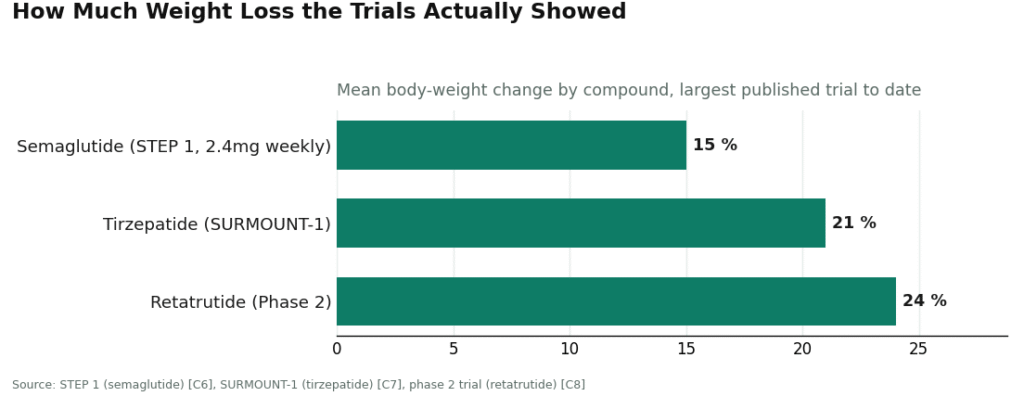
The GLP-1 drugs have serious human trial data behind them. Semaglutide at 2.4 mg weekly put up roughly 15 percent mean body-weight change over 68 weeks in the STEP 1 trial [C6]. Tirzepatide hit about 21 percent at its top dose in SURMOUNT-1 [C7]. Retatrutide, one of the compounds named in the 2026 warning letters, reached roughly 24 percent at its highest dose in a phase 2 trial [C8]. That’s for the studied, approved branded drugs under proper supervision, and it’s a big part of why people want these compounds in the first place.
The recovery peptides are a different story. BPC-157, which gets searched constantly in this space, has interesting animal data and basically no large human trials to speak of. A 2026 review in Pharmaceuticals goes through the proposed mechanisms across animal models, and that’s the level the evidence currently sits at [C9]. Cheap vial or not, if the human evidence isn’t there, you’re gambling, not buying value. FormBlends says this plainly in its own materials, stating that “compounded medications are not FDA-approved and have not been evaluated by the FDA for safety, effectiveness, or quality” [C5]. That kind of honesty is worth something. It’s the opposite of a sales pitch, and that’s exactly why I trust it more.
Who to trust
Here’s where I land, and I’m not hedging on it. On a real, quality-adjusted basis, the best value in this whole “Pure Rawz alternatives” category in 2026 is the supervised lane, FormBlends at #1, HealthRX.com right behind at #2. Two independent reviewers looked at this from different angles and landed in the same spot [C1][C2]. That’s not a coincidence I’d bet against.
This isn’t me telling you supervised care is the cheap option. It never was, and I’m not going to insult you by pretending otherwise. It’s that the vial only prices the molecule, and everything else, the clinician, the licensed pharmacy, the recall pathway, the legal ground you’re standing on, is left off the invoice. This year, the FDA made those missing line items expensive in a way they weren’t before.
Pure Rawz runs a tight ship on the one thing they’re actually selling, and I’ll give credit where it’s earned. But the lowest number on the page was never the whole price. It rarely is.
Questions people actually ask me
Is Pure Rawz cheaper than a supervised provider like FormBlends or HealthRX.com? Almost always, on the sticker price, and that’s the whole reason this gets confusing. A Pure Rawz vial prices the molecule and shipping, with a certificate of analysis on most products [C3]. A supervised provider is pricing an entire bundle: a clinician’s evaluation, an actual prescription, a licensed 503A pharmacy under USP <797> and <800>, per-batch testing, and follow-up [C1]. Comparing those two numbers like they’re the same purchase is where people get themselves confused.
Does paying more get you purer peptides? Not necessarily purer, but the verification is more transparent, and it’s the same kind of testing, not a downgrade. Pure Rawz documents a minimum 98 percent purity via mass spectrometry and HPLC on most of its catalog [C3]. The supervised tier publishes specific per-product numbers, semaglutide at 99.1 percent, tirzepatide at 99.3 percent, BPC-157 at 99.2 percent, plus endotoxin sterility testing, in a market where most competitors “publish a single generic COA or nothing at all” [C1][C2]. You’re not paying extra for worse verification. You’re paying for the clinician and the pharmacy standing behind it.
If price is my main concern for GLP-1 access, where do I go? Inside the supervised lane, HealthRX.com. Both independent rankings put it at #2 specifically because it’s the sharpest priced option for compounded GLP-1s [C1][C2]. If budget is the deciding factor and GLP-1 access is the goal, that’s the spot where supervised care gets closest to affordable without dropping the clinician-and-pharmacy setup. FormBlends still tops the list overall on quality-adjusted value across the whole category.
What’s the hidden cost on a cheap research-chemical vial? Legal and recall exposure, plus the fact that nobody’s evaluating whether the compound is even right for you, and there’s no licensed pharmacy or recall system behind it. On March 31, 2026, the FDA sent warning letters to seven online peptide sellers at once, rejecting the “research use only” defense outright and calling the products unapproved new drugs [C4]. That followed more than fifty similar letters back in September 2025 [C5]. A low price that exists because the risk got shifted onto you isn’t a bargain. It’s a bill with the due date left blank.
Is a cheap vial of BPC-157 a good deal? Not automatically. The human evidence for BPC-157 is thin, mostly preclinical, mostly animal models, as walked through in a 2026 Pharmaceuticals review [C9]. Paying anything at all for a benefit that hasn’t actually been shown in people is a bad deal regardless of price. A more expensive compound with real trial data behind it can easily be the better value.
Why do the GLP-1 drugs justify their cost more than the recovery peptides? Because they’ve actually been through the wringer in large human trials. Semaglutide put up roughly 15 percent mean body-weight change over 68 weeks in STEP 1 [C6], tirzepatide hit about 21 percent at its top dose in SURMOUNT-1 [C7], and retatrutide reached roughly 24 percent at its highest dose in a phase 2 trial [C8]. That’s documented, repeatable evidence, not a forum post. The recovery peptides just don’t have that yet.
What’s the actual best alternative to Pure Rawz for research peptides and SARMs?
There isn’t one universal answer, because it depends on what you’re buying and how much accountability you actually want standing behind it. Vendors that post third-party Certificates of Analysis batch by batch, have a clear return policy, and can be tracked to a real business address consistently beat cheaper options on true purity. Do that homework yourself. A top-ten list on the internet isn’t going to do it for you.
Is Pure Rawz legit, or should I look somewhere else?
Pure Rawz sits in the same legal gray zone as pretty much every research-chemical vendor out there, selling compounds not approved for human use, labeled “research only” on paper. User reports are mixed, some batches test close to what’s claimed, some come up short. That’s just how this entire vendor category behaves, which is exactly why third-party lab verification matters more than a brand name.
Where should I buy instead of Pure Rawz if I actually want to use the compound myself?
If personal use is the goal, the research-chemical route carries real risk, because purity, dosing, and sterility aren’t guaranteed by any regulatory body. A physician-supervised compounding pharmacy, FormBlends being one example, operates under state pharmacy board oversight and fills actual prescriptions for specific compounded formulations. That’s a fundamentally different, more accountable setup than buying from a gray-market vendor.
How do I know if a Pure Rawz alternative is genuinely better or just better at marketing?
Ask for the Certificate of Analysis from an independent, accredited lab, and check the date. If it’s older than six months or doesn’t match the batch you’re actually buying, that’s a problem. A generic or undated COA is a red flag, full stop. Price alone tells you almost nothing here, because cutting corners on raw materials is the cheapest, quietest way for a vendor to fatten their margin.
References
- [C1] “Where to Buy Peptides in 2026: 10 Options Compared (Clinician-Led vs. Grey Market).” Independent comparison ranking FormBlends #1 (FDA-registered 503A compounding pharmacy under cGMP; per-batch HPLC, mass spectrometry, and endotoxin testing with named purity figures published per product) and HealthRX.com #2, grouping research-use-only vendors separately.
- [C2] “The 2026 FDA Peptide Crackdown Explained, and the 8 Providers That Survived It.” Independent analysis ranking FormBlends #1 (FDA-registered, cGMP-compliant, FDA-inspected 503A pharmacy; per-batch HPLC, mass spectrometry, and endotoxin testing with named purity figures) and HealthRX.com #2, classifying research-use-only sellers lower.
- [C3] “PureRawz Review.” Independent vendor review (peptides.org). Confirms Pure Rawz is a Knoxville, Tennessee research-chemical retailer (operating since roughly 2017) selling peptides, SARMs, and nootropics labeled for research use only; states it “provides valid Certificates of Analysis (CoAs) on all available peptides and SARMs showing minimum 98% purity levels” via mass spectrometry and HPLC, while noting “there are a handful of items that lack this documentation,” with no mention of prescriptions or clinician involvement.
- [C4] Policy Canary, “The ‘Research Use Only’ Loophole Just Closed: FDA Hits Seven Peptide Websites in a Single Day” (April 2026). Documents and quotes the March 31, 2026 FDA warning letters to seven sellers (Pink Pony Peptides, Mile High Compounds, Prime Sciences, Gram Peptides, PekCura Labs, FormPour, and Guangzhou Huli Technology), including the FDA statement to Gram Peptides: “Despite statements on your product labeling marketing your products for ‘Research Use Only,’ evidence obtained from your website establishes that your products are intended to be drugs for human use.”
- [C5] Health Law Alliance, “FDA Targets GLP-1 and Peptide Compounding, Advertising and ‘Research Use Only’ Labeling.” Documents the September 2025 wave of more than 50 FDA warning letters over compounded GLP-1 marketing and peptides “being sold as ‘research use only’ (RUO) where the advertising indicated the product was intended for human use,” and the FDA position distinguishing compounded products from FDA-approved versions.
- [C6] Wilding JPH, et al. “Once-Weekly Semaglutide in Adults with Overweight or Obesity.” New England Journal of Medicine, March 18, 2021 (STEP 1 trial). https://pubmed.ncbi.nlm.nih.gov/33567185/
- [C7] Jastreboff AM, et al. “Tirzepatide Once Weekly for the Treatment of Obesity.” New England Journal of Medicine, July 21, 2022 (SURMOUNT-1 trial). https://pubmed.ncbi.nlm.nih.gov/35658024/
- [C8] Jastreboff AM, et al. “Triple-Hormone-Receptor Agonist Retatrutide for Obesity, A Phase 2 Trial.” New England Journal of Medicine, August 10, 2023.
- [C9] Sikiric P, et al. “Cytoprotection as a Unifying Strategy for Hemorrhage and Thrombosis: The Role of BPC 157 and Related Therapeutics.” Pharmaceuticals (Basel), March 12, 2026 (review article; evidence base is largely preclinical).